Saturday, 7 May 2016

Jane's Walk 2016 in Haskovo: "Once upon a time... there was a river"

This year we decided to organize Jane's walk along the river. This is the famous river from Shturcite's famous song "Sreshta". The river crosses the city from west to east, and divides the town on two parts. It runs through the center, and shapes its form, size, and infrastructure. For good and for bad, the river is an important part of our city. But fifteen years ago the local authorities decided to cover the river with concrete and made parking lots and shops on it. How can we re-integrate the river as an element of our city's landscape? How can take it back and reconnect with it? How to shift our perception about it from a channel to a lively place?

We walked, observed and thought on these questions. During our walk, new questions came out and we are now full with impressions, thoughts and ideas.
At the Meeting point. Some people who got know each other. The retired school teacher Todor Stratiev brought some old photographs from his childhood, presenting what the river was like 50-60 years ago. The environmentalist Mariana Valcheva was interested. 

More people gather together. Our walk is bycicle, pets, and children friendly, so +Simon Zenopian came with his bike, and +Lydia Staikova and myself came with our son Petar. +Hristo Dimchev brought an Eeyore-like mood, but  eventually he replaced it with beer. 

Several decades ago, the river was full of water and fish. Why everything changed? Todor Stratiev explained: "For agricultural reasons, the government build a dam in a village nearby, so the most of the water is used for watering the plants. The river became just a small stream, so in few years the young lads caught all the fish." Sad, isn't it?

We saw that some of the most significant places in Haskovo are located by the river. Here we are posing on the bridge to the old school. During our walk we decided that the bridges' number is too small. There is a need for more pedestrian bridges. 

This plate on the school's wall memorize that on this place the great Bulgarian national hero Vasil Levski founded a secret revolutionary committee for the liberation of the Bulgarian nation from Ottoman rule. 

 Near the river there are two Renaissance Orthodox churches. 
This is the first one, and it's dedicated to Virgin Mary. 

 A rock with a humble script in memory of 70 innocent Bulgarians, hanged by the Ottomans. 


The second church near the river, dedicated to Archangel Michael. 

This photo testifies how the river was covered with concrete and shops were build on it. 
Is this what the river deserves? Is this what the citizens deserve?

One of the many tobacco stores in Haskovo. The city was a major center of 
tobacco industry in Bulgaria. 
 The (only) theater of Haskovo.

The former headquarters of the Bulgarian communist party in Haskovo. 
Nowadays it is a business center.


Seventy years ago this place was known as The Jewish park. In this area lived the Jewish community of Haskovo. Almost all of our Jewish fellow citizens moved to Israel in the late 1940s.

 Former headquarters of the tobacco company. 

One of the most important bridges in Haskovo. This is the main connection of the south part 
of the city with the center and the rest of the neighbourhoods.

Then we passed several important sites located along the river: the regional branch of the University for National and World Economy, two hypermarkets, and the football stadium "Mladost". Obviously, the boulevard along the river is a concentration of major landmarks and social places in our cities. 

And finally we closed our long walk with the traditional and unique contribution of 
Haskovo to the Jane's Walk movement: Jane's beer. :)


Sunday, 13 December 2015

Connecting people and building a community through petanque

The important thing in community building is to create an environment and activities that gather together people, and give them opportunity to communicate and share. So community building is about certain lifestyle features.

Here is our experience with petanque - a French game with balls.

Petanque is a great game, because:

1. There is not great physical effort, so even children, people with disabilities and older people can play it.
2. This is a very social game - people can talk and drink beer or juice while playing.
3. It is easy to learn game with simple rules (but not simpler than they should be).

We started in 2008, and we were just two enthusiasts, but year after year we involved more people. We even participate in tournaments. It is a great example how people who don't know each other become closer and create friendships. From two in the beginning to twenty now - we created a community of people, who have made connections, have build a network and eventually some of them have started some side projects. :)


We have fun.


We play in different seasons, on different terrains. Only snow and hard rain can stop us.


Tuesday, 22 July 2014

Harmanli - the gateway to the European Union (in French)

For more than 10 months our organization has been helping one of the most vulnerable groups in our society - refugees. Here is a reportage of a French TV about Harmanli camp. It is located in the town of Harmanli and it's the largest of the seven administrative centers for migrants seeking asylum in Bulgaria. 

It was opened  in October 2013, and accommodates for more than a thousand refugees.

The video includes an interview with Mrs +Lydia Staikova  - a Bulgarian volunteer and chairman of our NGO +The Garden Association from Haskovo. 

Sunday, 4 May 2014

Jane's Walk 2014 in Haskovo: "In search of the castle"

This year Jane's Walk took place in the neighborhood of "Hisarya." Again, Haskovo is the only Balkan city which participates in the global Jane's Walk initiative. 

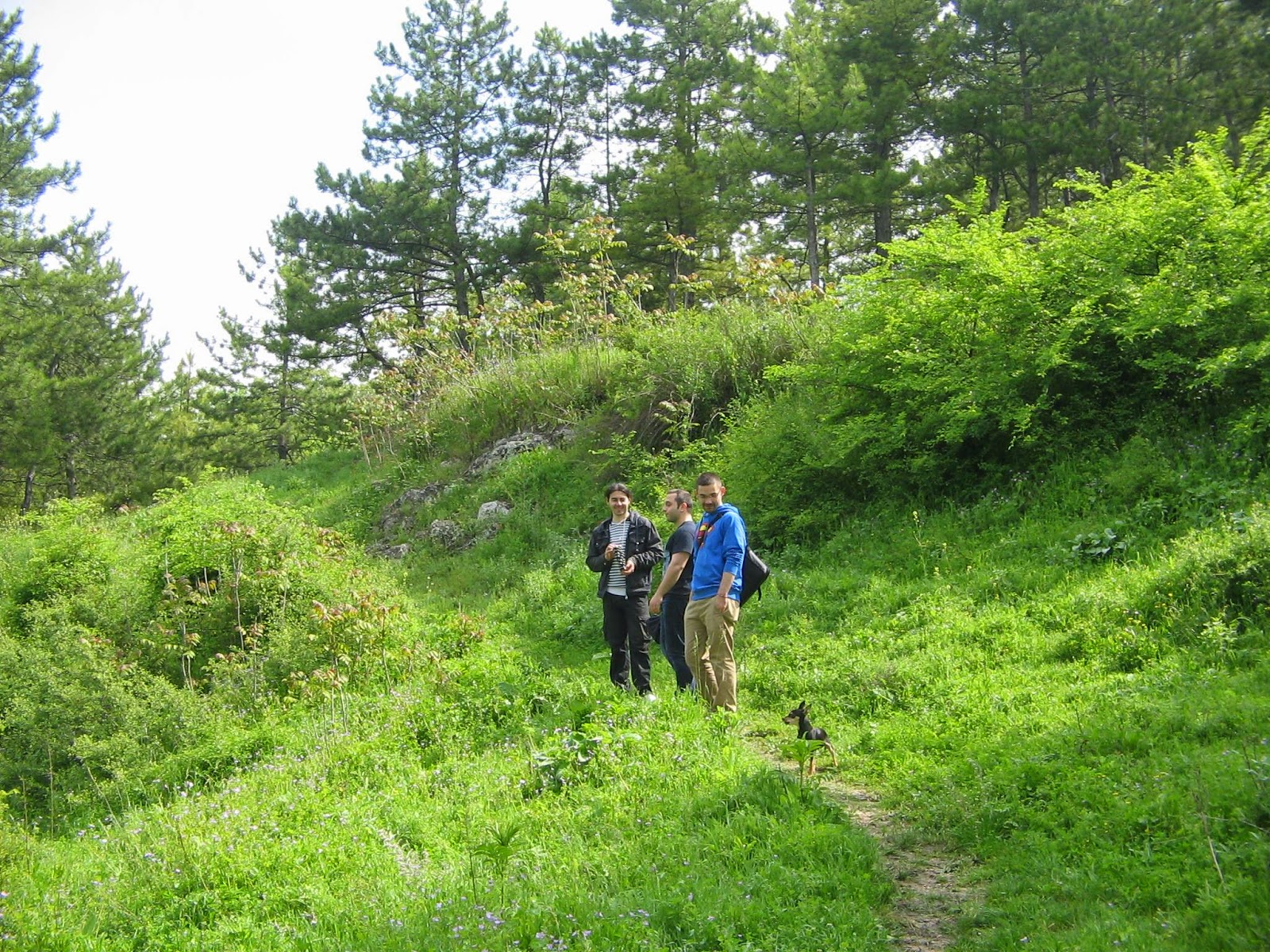
On 3rd of May, we walked in the foot of the hill where the fortress was built, and then climbed it to discover the foundations of the walls. And meanwhile, we have been discussing. 

What we have discussed? 

1. How the medieval town was created and how the town relocated its center through the centuries? 

2. How the municipality and the local people could use for public benefit this old fortress? How they could develop the potential of this historical heritage on order to strengthen the town's millennial identity and to improve the general quality of life? 

3. How can people recreate this part of the contemporary city and transform it into a vital place? Things like restoration, infrastructure, transportation, new parks, etc. 

The meeting point - a nice park with many trees.

During our walk we found a small square with well and and plaque. On the plaque it is written 
that the local industrialist Stoycho Marchev has done the well in 1926, 
according to the deathbed will of his late father. 

The square has no name, and I think it would be cool if the municipality name it 
after the donor Stoycho Marchev who has done well.

Informal green place for meetings and communication in the neighbourhood. 

And now look - just 5 minutes by car from the city center, we are out of the civilization - 
the asphalt is over. A dirt road begins. Plenty of meadows around. 


  A small stream flow nearby. 

Wow! 5 minutes distance by car from the city center of Haskovo, and you are in a different world. Biodiversity, connection with nature, fresh air, open space - this is what the foothills of the castle offers to the curious traveler. 

 In the foothills of the castle there is a small charming forest.

 Some of us were younger and they quickly quickly outpaced the others. 


 And the ruins of the castle are here. 


10 centuries ago, this place was the heart of the medieval settlement. Craftsmen and farmers lived around, and some artifacts were discovered by the archaeologists few decades ago. Nowadays, the ruins are is at the end of the town, and expect us to find our way back to them. 


View from a bird's eye: 

Tuesday, 15 April 2014

Talks at The Garden

Since the beginning of the year we started a new project: a series of public Google Hangouts, called TALKS AT THE GARDEN. We present ordinary people, engaged with socially significant activities in various domains: social activisism, creativity, self-organized initiatives, and so on.

Here are the first three "Talks at The Garden":

#1 - There Will Be Once Upon a Time: What is the Future of Storytelling? 

Conversation with the authors & publishers +Zornitsa Hristova and +Nikola Raykov. Zornitsa created a great game for development of children's storytelling skills. Nikola created an intriguing game-book for kids. 


#2 - Lost in the Narrative, Found in Internet 
Conversation with +Ivailo Tarpanov (administrator of TVseriesBG.com - a site which initiate a competition for a short story), +Dimitar Chakarov (writer, whose short story Bar Desire won the competition), and +Kiril Totev (a film director, whose studio will make a movie, based on Bar Desire). The amazing thing is that their budget is 300 (three hundred!) Euro.


#3 - Making good! 
Conversation with +Alexander Makedonski from Moga, a small NGO from a small town. With a few money and a lot of volunteer work, the achievements of the guys from Moga became nationally popular via the buildboards of Coca-Cola. 

We plan a lot of new public hangouts in Bulgarian. We hope that our hangouts will contribute for the development of a more creative and socially sustainable public environment in the Bulgarian society. 

Wednesday, 18 September 2013

Chernichevo Chronicles: the community narrative as a tool for community development

The Garden Association sets Community development as one of our the fundamental goals. In the last years we've been involved in small community organizing activities in the mountain village Chernichevo. We had the chance to use Community psychology in order to support the community development through the principles of community empowerment, community identity based on traditional local know-how and cultural uniqueness, place attachment, participatory decision-making, and social entrepreneurship skills [1].

One of the tools that we used to strengthen the locals' sense of identity and togetherness, was the technique of narration. Elderly people from the village (or from the diaspora in the bigger towns of the country) shared their memories about the past lifestyle, culture and traditions of the village, and their own experience. We recorded with my camera these narratives, and then I shared them with the village's Facebook group. The reactions of the group members prove that this approach was a success. The recordings carry the impressive name Chernichevo chronicles. (We chose it by purpose, because it sounds epic, and we wanted to provoke the people to think about their village as an epic village).

* * *
Here are some videos from the series Chernichevo chronicles (they are all in Bulgarian):

Angel Stankov:


Kiro Anadoliev:


Husein Banchev:


Dobrinka Kalaydzhieva - Anadolieva:


Kera Valkova- Garabetova:


Pavel Haritov:


- - - - - - -

[1] By examining and implementing the values and the methods of Community psychology, we supported the development of social entrepreneurship skills for community benefit. This eventually led to the reestablishment of the village's Community center as a place for grassroots activism. The biggest achievement of the local activists was the creation of female group for authentic folklore. The recent news is that Chernichevo's folklore-group won a silver medal from the 1st Balkan Folklore Festival in Nedelino town, the 7th and 8th of September 2013.

For the fifth consecutive year: "Introduction to Psychology"

During the course we'll try to find out
what's on the man's mind :)


For the fifth consecutive year the Open School Psychology at The Garden Association organizes the course "Introduction to Psychology". 

For whom the course is? 

The course is designed for students from 10th to 12th grades. 

These, who want to study psychology, will learn what is psychology as a science, and what they may work after graduate from university. 

Those, who want to study other disciplines, but still are interested in psychology, will learn how to use psychology in their fields of activities. 

What will you get? 

At the end of the course, you will have a wider general knowledge, better skills to understand the world, you will know more about yourself, you will gain a valuable social experience. 

You will learn what are the methods of psychology and how to apply them, in what areas of life is used psychology, and how they can use psychological knowledge in everyday life. 

We'll have fun and learn at the same time - in the natural way that good things happen. 

How the course works? 

The course includes short lectures and many interactive forms to work. 

Weekly workload would be about 5 hours a week. Half of the time will be used for group classes , and the other half - for independent work at home. 

During the course each participant will receive two times an individual feedback from the trainer. 

Who are we? 

Open School of Psychology is an initiative of The Garden Association - Haskovo. 

We organize this course for the fifth consecutive year. 

Our office is in the town of Haskovo, 26-A "Rakovsky" Blvd., 4th floor. Check it out :


View Larger Map