Saturday, 1 June 2013

Support for the civil society in Turkey

The Garden Association supports the civil society everywhere in the world. We express our sympathy to the protests that started in the previous three days in Istanbul, Ankara, Izmir and many other Turkish cities. But we are strongly worried about the recent events in Turkey. 

Source: Internet
The Turkish government, led by Mr Erdogan, wants to demolish the only green space in the center of Istanbul - Gezi park at Taksim square. It plans to build a new cultural-market center (a kind of mall) in the style of ancient Ottoman military barrack. In this case government offences the Turkish society in two ways: 

First - environmental. The project envisions the destruction of a very important green space in the heart of the city. Along with its significance for the urban environment, Gezi park is a place for many non-formal cultural activities and outdoor meetings. 

Second - political. The government's project, taken in a wider perspective, is just one step (of many) for the rehabilitation of the Ottoman empire. The ideology of Erdogan's party is often described as neoosmanism. It is also Islamist and anti-secular in its roots. The project tries to change the symbolic significance of Taksim square. In this area of Istanbul is the monument of Mustafa Kemal Ataturk, this is one of the symbolic places of the Turkish republic. 
The night of 31st of May - 1st of June. Protesters on the Bosporus bridge. Source: Internet.
So many people see the struggle for Gezi park as a struggle for the Turkish democracy. Thousands and thousands of Turkish citizens protest in all big cities of the republic. They struggle to preserve the secularity in the republic of Turkey, the basic principles of democracy and freedom of speech.

Unfortunately, the peaceful protesters were attacked by the police with gas! There is a brutal police violence and are hundreds of injured people, but the mainstream Turkish media doesn't broadcast anything of this!

The bridge of Bosporus today, 1st of June 2013. Greetings to Turkey!
Source: Internet

As a non-governmental organization, we, the team of The Garden Association, want to express our solidarity with the protesting citizens of Turkey. Among the people who protest the governments' policy in Turkey there are many people who we personally know and respect: Prof. Okan Cem Çırakoğlu from Başkent University in Ankara, Prof. Hikmet Sivri Gökmen from Dokuz Eylül Üniversity in Izmir, PhD candidate Türkan Fırıncı from Gazi Üniversity in Ankara, Ms Elif Kayran from Izmir Children's Atelier, PhD candidate Özgür Devrim Orman from Boğaziçi Ünversity in Istanbul, and many nice university students.

Don't give up, komşular! The free world is with you!

What the active citizens in Turkey want? Source: Patrick Heath 

If you wonder why Turks are so upset - this is why!


Live broadcasting from Istanbul:


Wednesday, 8 May 2013

Jane's Walk in Haskovo: "Ovcharcki - The Neighborhood of the Shepherds"

On the 4th of May, Saturday, we organized "Jane's Walk" for a first time in Bulgaria and on the Balkan peninsula, and in Eastern Europe. After we made the first Google hangout on social and political issues in Bulgaria, the team of The Garden Association became a pioneer in another important subject. 

Jane's Walk is an international initiative, run by a group of friends, supporters and followers of Jane Jacobs - the prominent urban development thinker, social activist and community organizer. It is a very simple idea - each year people from the city get together and walk across a certain neighborhood, led by a local volunteer, called walk leader. They discuss the story of the neighborhood, its identity, its open spaces' specifics and walkability, and eventually whether it is friendly for living and what could be done for the life of the local community to be improved.

Jane's Walk is very famous in Canada and the US and gradually becomes popular in Western Europe too. But in Eastern Europe, and in particular the Balkans, it is still an unknown event. There are initiatives like Free Sofia Tour, led by volunteers, but they provide mainly free guide services for the foreign tourists and their goal is the make foreigners more familiar with the landmarks of the Bulgarian capital's center.

How we went into this? 

I discovered Jane's Walk last year, while searching for more information about Jane Jacobs' activism. I thought that it is a great initiative and that The Garden Association should take part in this. We are admirers of Jane Jacobs. Our chairman +Lydia Staikova has read many Jacobs' works. Also, I have a professional interest in the fields of Environmental psychology and community development, which are related to some of the issues that concerned Jane Jacobs.

The Walk itself

I must say that the Walk is always held in the first weekend of May in honor of Jane's birthday. So we chose 4th of may, Saturday. But first of all, I registered myself as City organizer in the Jane's Walk website and then I registered my walk "Ovcharcki - The Neighborhood of the Shepherds" and made this Google map:

Then I made a Facebook event and I invited my fellow-citizens who would be interested in this walk.

The Green Corner - I took photo for the
FB event from Google Street View.
And The Day came. At the appointed time and at the appointed place the people started to gather, one by one. The Meeting Point is a significant place: in the past, about 70 years ago, it was the School of Nursing in Haskovo. It is at the crossroads of "Makedoniya" Str. and "Osvobozhdenie" Blvd. and here is the western border of my neighborhood "Ovcharski."

The first walkers come. 
At the background - the 
former School of Nursing.
For many years this building has not been a School of Nursing. It is the headquarter of municipal company for funerals. But I gave a better name for this location: The Green Corner. First, because the building is painted in green, and second, because at the street there is a the small garden with green bushes.

Our walk started on "Makedoniya" Str. - one of the two streets, alongside with "Dragoman" Str., which cross the entire neighborhood from West to East (or the opposite). Stop One was the Fire Station. Since the day when it was founded, the Fire station of Haskovo has been located at this place. Many years ago, the first firemen used wagons with horses and barrels of water to extinguish the fires. See the Fire station via Google Street View:


We discussed the fate of the horses in the time of the first firemen and then we continued the walk.
Walking and talking, after stopping - more talking :)
Stop Two. I call it The First Settlers, because here is the historical heart of the neighborhood. Here lived the founders of this neighborhood, and what gives me a special feeling is that many of their descendants still live here. The neighborhood was called "Ovcharski", because the first settlers were farmers and breeders, and especially because they had a lot of sheep (Bulgarian: "Овчарски"; English: "Shepherd's neighborhood"; Turkish: "Çoban mahalle").
Now we are at the historical heart of the neighborhood! I am very passionate while talking about The First Settlers, some of whom were my ancestors. They come here more than 160 years ago. By the way, do you see the lime tree - near this place there was a water fountain for the local people.
The church "Sv.Georgi"
Stop Three - the local Orthodox church "Sveti Georgi" (aka "St.George"). It was built by The First Settlers about 160 years ago, when the Bulgarian people was under the yoke of the Ottoman empire. The church was named after Saint George - the protector of the shepherds (and you remember that "Shepherd's" is the neighborhood's name). Through the years three men from my family were members of the church board.


Stop Four - the park. Now this place is a park, but it was intended to be something different. In the late 1940s the local people planned to build a new and more beautiful church for their neighborhood. But the communist regime, which came to power in this time, was atheistic and anti-Christian in its nature, so the plan failed... Well, at least now we have a park with playground for the kids. See the park via Google Street View:

Stop Five - the small (and nameless) square with the building of the local Community center. In the past the building did not exist and the small square was a bigger place where the local people celebrated their feasts and made their gatherings with traditional songs and folk dances. Around 1950-1955 this wonderful tradition disappeared. I would not venture to say whether this was because of communism, or because of modernity, or both. As a location, in this period this square was at the end of the neighborhood, but actually this was its center, its main social space. Actually today it still has this function, because here is situated the local community center, and there are two grocery stores and a small open market for fruits and vegetables. As for the Community center, today its social function is limited to give shelter of the local pensioners to play cards and board games. See it via Google Street View:
The local people call the school "Otec Paisiy"
(in English "Father Paisiy").

Stop Six - the school "Sv. Paisiy Hilendarski" (St. Paisiy of Hilendar) which was initially created as a church school at the church "Sv. Georgi" (see Stop Three). Later a separate building was built, more relevant to the educational needs of the local community. But even in a separate building, we must remember that the school (as an institution) is a direct continuer of the church school. Four generations from our family had studied in this school.


Here the walk finished. Saying Thank you! to the walkers.

After Jane's Walk we decided to have a Jane's Beer at the local pub.

NOTE: Totally 12 people and one dog joined my first Jane's Walk. They are: +Hristo Dimchev, Veselin Harmandzhiev, Plamen Moskov, Petronka Stankova, Petar Stankov, +Lydia Staikova, Mariyana Valcheva, +Simon Zenopian, Petya Skerleva, +Vladimir Grachki+Yanko Zaprianov and +Kiril Hristov
The dog's name is Casper.


Saturday, 27 April 2013

Today we launched our first Google Hangout: "Bulgaria in 2013 and beyond"

Today is a historical day! The Garden Association launched its first Google Hangout: Bulgaria in 2013 and beyond

We are pleased to inform you that this is the first hangout on social and political topics in Bulgaria, so our event had a really historical meaning. We want to use the new information technologies and social media for the benefits of the civil society, and Google Hangout is an excellent tool to achieve this purpose. 


We see Google Hangouts as a tool for the development of direct democracy by small communities and civic groups, which can share and discuss ideas with the rest of society. In times of a severe political, social and economic crisis in Bulgaria, we invited several prominent social activists and thinkers to share their opinions and ideas on the overarching theme "Bulgaria in 2013th and Beyond".

Our guests were:
+Denitsa Sacheva - PR expert, professor of Political communication at New Bulgarian University, nominated for the award "Human of the year 2012" in Bulgaria, known for hew humanitarian work with immigrants and refugees, who suddenly switched her social role and decided to go into political life.
+Bogomil Shopov - a prominent blogger and activists for internet rights and access to information, co-founder of the NGO "Electronic border", ex-candidate member of the European parliament, co-founder of the Bulgarian Pirate party.
+Polina Paunova - journalist from the highly respected website Mediapool.bg and co-founder of the non-formal alternative media group "Angry Young Men" who broadcast various social actions, which are usually not covered by the "traditional" mainstream media.
+Todor Tanev, PhD - professor of Political Science and Head of Public Administration department at Sofia University "Sv. Kliment Ohridski", expert of strategic planning, who took part in the creation of the National strategy of Armenia.

Our additional guest was Mr +Ivan Delchev, entrepreneur and internet marketing expert, co-founder and co-owner of a small company, where he is heading the Quality Assurance department.

The hangout's topics were: how did we get here, what happens with the civil society in Bulgaria, what are the similarities and differences in the protests of 2012 and early 2013, how citizens can influence the politicians, what needs to be changed in this country and how, what must be the very first priority for the new state's government, and so etc.

Because of our lack of experience, we made one weakness in the hangout: the side noise. I was in a hurry and I choose a place nearby the street. Also one participant's washing machine was working :) But still it was an experiment, there was a meaningful conversation with great participants, and, Gosh, we did it!


Saturday, 9 March 2013

The Men's mythopoetic society of Haskovo

Robert Bly at his reading. Photo from Wikipedia.
Today I started an initiative, which I was dreaming about for a long time. 

I wanted to create a men's group. A group for young men.

The idea of the mythopoetic men's movement was created by the American poet Robert Bly. He insisted that the current society hurts the men's souls and changes the millenniums old tradition of men's growth. 

The concept

Bly's book "Iron John: A Book About Man" is a seminal work, which inspired thousands of men to seek for their personal, spiritual and social development. The name of the book was taken from the fairy tale "Iron John (or ""Iron Hans") from Brothers Grimm's collection. This is a story about the maturing and growing of a young man. The mentor's role is an important element of this fairy tale, because John grows with the help of a wild man.

Bly is not anti-women. He is pro-men. Bly respects the women's need for development and independence, but underlines that men have the same need. Especially today, when men grow surrounded by women, without the presence of a significant male role models in the most of the day. Since the early 1980s Bly apply his deep visions of the new reintegrated and strengthened men through series of workshops for men. This initiative eventually gave birth to the Mythopoetic Men's Movement.

The methodology 

The movement led by Bly is very influenced by C.G.Jung's ideas about archetypes. The men's gatherings are focused on issues like gender role, gender identity, and emotional and psychological well-being of the modern man. Men just think and talk, and then listen to others, and then rethink and talk again. The workshops often use storytelling with musical accompaniment. The purpose of the workshops is to empower men by giving them archetypal characters which could explain their own emotions and abilities.

So after several weeks of preparation, today was the first meeting of (what I call) the Men's Mythopoetic Society of Haskovo. I salute these brave and open young men - all in their mid-twenties - for their will and for their courage to explore, share, discuss and grow their male souls.

Dear Veselin, Hristo, Simon, Plamen, Vladimir and Evgeni, - you are all great!

* * *
Parts of "Iron John" (thanks to Google Books):

Sunday, 9 December 2012

The Garden Association at Sofia Architecture Week 2012

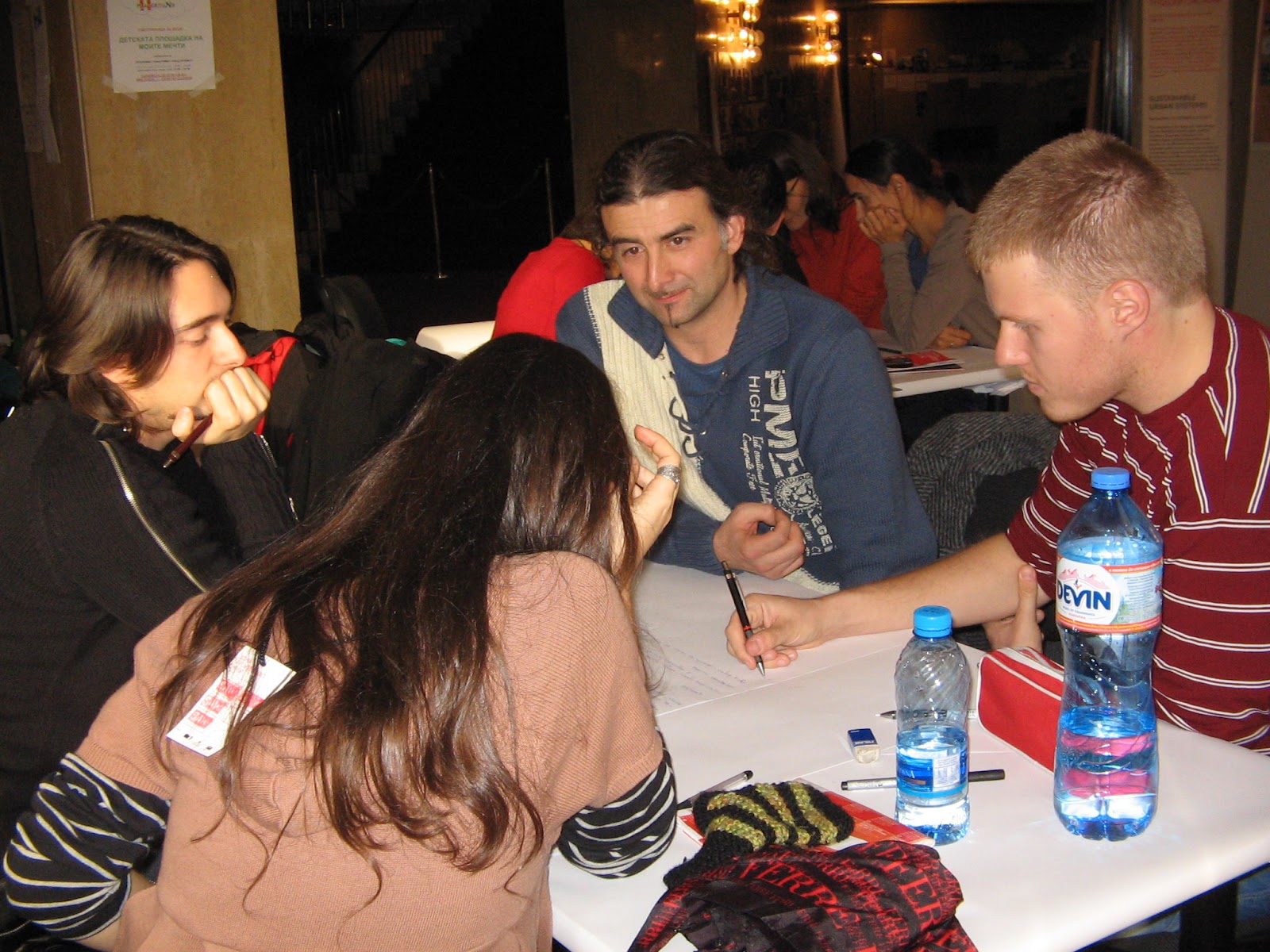
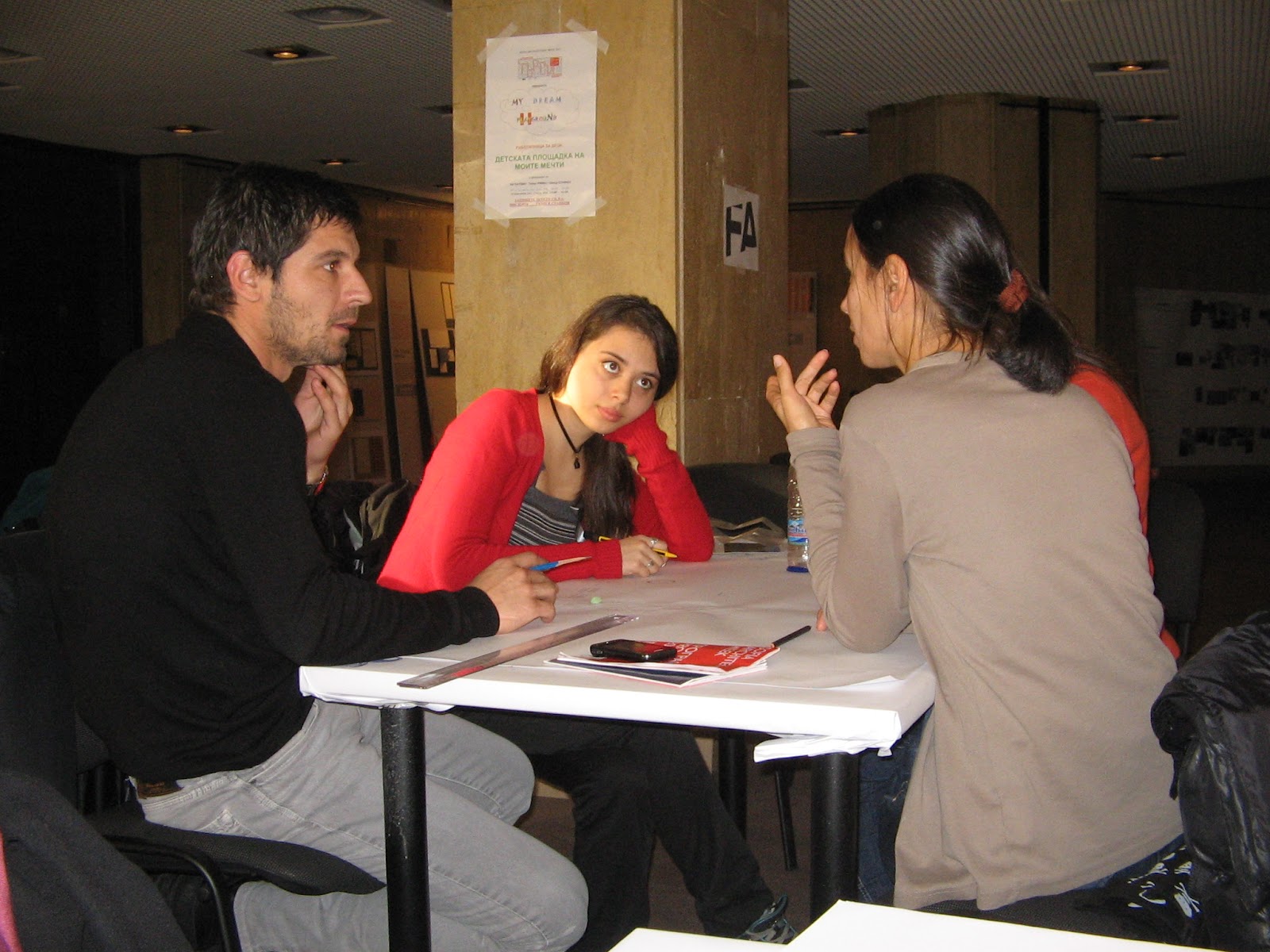
The Garden Association participated in Sofia Architecture Week 2012 - an international event, which was organized from the 26th of November to the 2nd of December. Our representatives +Turkan Fırıncı   and +Georgi Stankov were hosts of two workshops and one lecture, provided in collaboration of Mrs +Elif Kayran - the head of Izmir Children Atelier

THE FIRST WORKSHOP

Our first workshop was held on Wednesday, the 28th of November. Its name is "My Dream Playground" and we made this workshop for a first time during Izmir Architecture Week 2012. 

Workshop's primal idea is to support the process of children's participation in today's society, and to involve children in the decision-making process regarding their own environments, spaces, and valuable places.

Methodology: 

We achieved this goal by getting together children and  professionals, who design children's environment: architects, designers, urban planners, and so on. Before the workshop we trained the professionals how to work with children, by enhancing their social competence and communication skills. Then we invited children from elementary schools to work collaboratively with the adults and to create common projects. The results were very encouraging!


THE SECOND WORKSHOP

The second workshop was a brave experiment, entitled "Playgrounds, Ideas and Ideologies", and we held it on 29th of November. We invited the participants of the workshop with the following tempting proclamation:
Is it possible that playgrounds reflect ideological concepts? This workshop will give you an open space to:
 - explore how specific ideologies, social trends, public attitudes, and concrete historical events might reflect the surrounding environments, including children’s ones
- create your own society with history and... playgrounds
- discuss and share creative ideas with others. 
Methodology:

We started with presentation on the influence which various political events, social issues, economic, cultural and even ideological trends might have on the public design, and especially on the children's public spaces. At the second part of the workshop, we formed several small groups, and each of them made a simulation of a society and created design for children's spaces of this society. The participants had very different professional backgrounds: architects, economists, construction engineer, designers, web developers, students, house wives, entrepreneurs, and this rich diversity helped them to produce incredibly creative projects!


THE LECTURE 

On November 29th, the third day of our participation, we gave a Lecture on the research "Haskovo Playgrounds: In a Transition from Communism to the Modern Times" in Hall 6 of the National Palace of Culture. We presented the research and shared our basic findings, and after that we answered questions from the audience..

* * * * * * *
We are satisfied with our participation in Sofia Architecture Week 2012, and we believe that our humble contribution will give valuable insights to the architectural community in Bulgaria and abroad.
We would like to thank to the curators of SAW 2012 - Delcho Delchev and Valeri Gyurov, and to the program coordinator of SAW 2012 +Boyka Ognyanova for their great support! 

Sunday, 11 November 2012

Today's guest in Open School of Psychology - Ivan Delchev

by: Georgi Stankov

Today at Open School of Psychology we had a honorable guest - Mr +Ivan Delchev - co-founder and co-owner of Soft Consult Group. He is the head of the company's Quality Assurance department and a successful independent internet marketing consultant. 

Mr Delchev shared with OSP's students his company's experience and fundamental principles in management, leadership & co-leadership, staff recruitment and training, and the overall process of developing a new product from the initial discussion with the client, through the test and re-test procedures, to the final implementation. We also used Mr Delchev's competence and asked for his feedback on our very new Small world project.

Later we made an analysis of the interview with Ivan Delchev. The students discussed the psychological aspects of what we learned about the software development companies and their work. 

Photos in three steps:
We are very official... and stiff as trees :)
Ivan Delchev is the high man with white-grey shirt.

Here I show to students how to overcome the camera stress.

He-he... We rule!


We will upload the video from the interview with Mr Delchev in two weeks. Of course, we will inform you in time - this conversation is a worth watching!

Tuesday, 6 November 2012

Short report from OSP: recent deeds

by: Georgi Stankov

1st row: Seli, Yanko, and Krisi; 2nd row: Kito, Stoyo, Georgi, and Petya.
 Here is a very short report about what is going on with our Open School of Psychology.

As you already know, we started our first academic year three weeks ago with eight students. Fortunately, the group cohesion is growing. I have noticed that after three weeks of getting to know each other, now the members are more open, devoted and creative. On Sunday we were very productive. As result we built the foundation of our study of small world phenomenon via online social networks. By the way, the regular themes of the day were SWOT-analysis and smart-goals. I encouraged students to use these new tools while discussing and planning our team's next steps.

Two of our students were missing because of their SAT 1 in Plovdiv, but next week we will be together and hopefully we will work even more efficiently.


Moments from the discussion: the gents were enthusiastic and action-oriented, and the ladies were more skeptic and analytically-thinking-oriented. :)