Saturday, 9 March 2013

The Men's mythopoetic society of Haskovo

Robert Bly at his reading. Photo from Wikipedia.
Today I started an initiative, which I was dreaming about for a long time. 

I wanted to create a men's group. A group for young men.

The idea of the mythopoetic men's movement was created by the American poet Robert Bly. He insisted that the current society hurts the men's souls and changes the millenniums old tradition of men's growth. 

The concept

Bly's book "Iron John: A Book About Man" is a seminal work, which inspired thousands of men to seek for their personal, spiritual and social development. The name of the book was taken from the fairy tale "Iron John (or ""Iron Hans") from Brothers Grimm's collection. This is a story about the maturing and growing of a young man. The mentor's role is an important element of this fairy tale, because John grows with the help of a wild man.

Bly is not anti-women. He is pro-men. Bly respects the women's need for development and independence, but underlines that men have the same need. Especially today, when men grow surrounded by women, without the presence of a significant male role models in the most of the day. Since the early 1980s Bly apply his deep visions of the new reintegrated and strengthened men through series of workshops for men. This initiative eventually gave birth to the Mythopoetic Men's Movement.

The methodology 

The movement led by Bly is very influenced by C.G.Jung's ideas about archetypes. The men's gatherings are focused on issues like gender role, gender identity, and emotional and psychological well-being of the modern man. Men just think and talk, and then listen to others, and then rethink and talk again. The workshops often use storytelling with musical accompaniment. The purpose of the workshops is to empower men by giving them archetypal characters which could explain their own emotions and abilities.

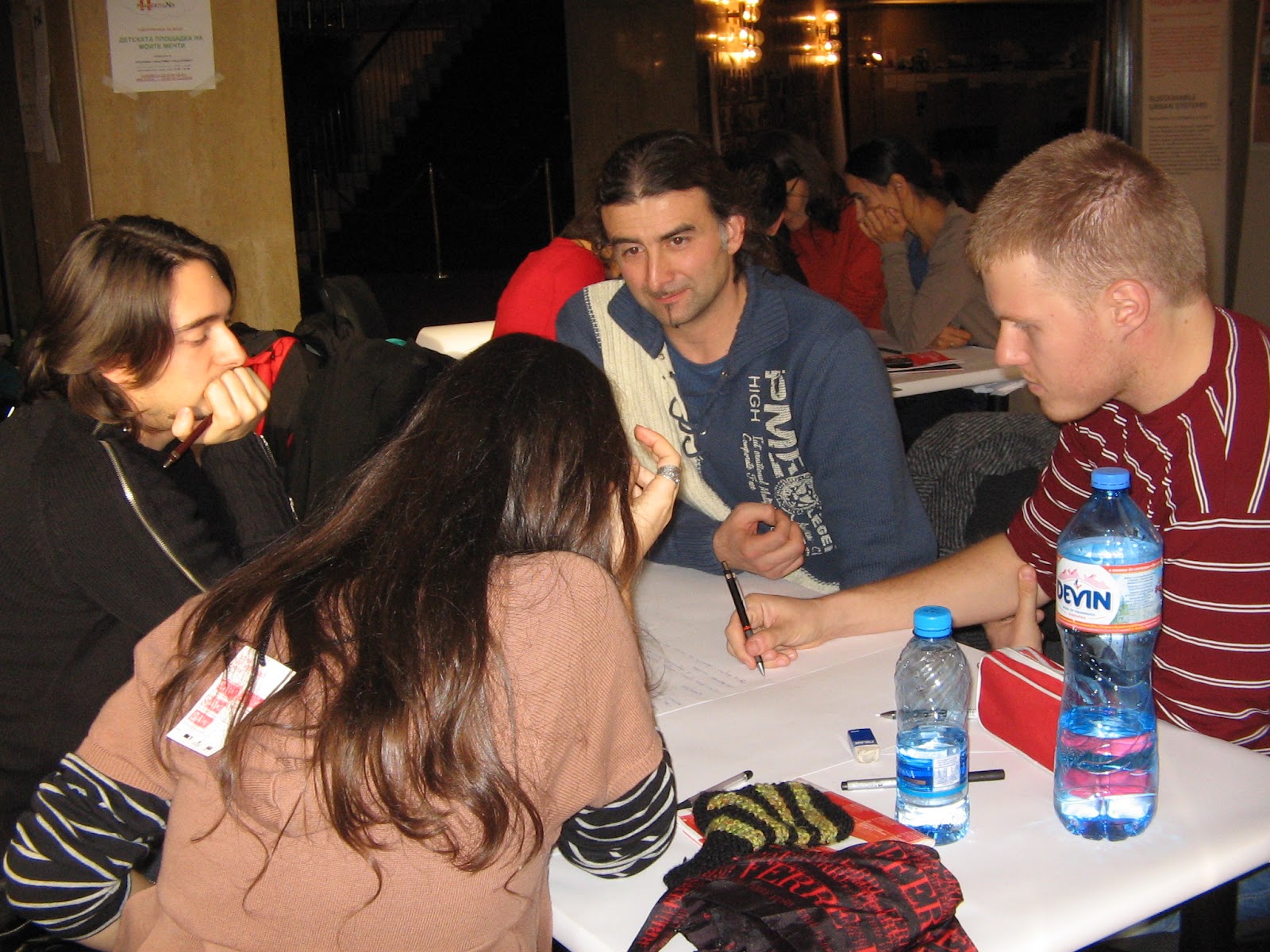
So after several weeks of preparation, today was the first meeting of (what I call) the Men's Mythopoetic Society of Haskovo. I salute these brave and open young men - all in their mid-twenties - for their will and for their courage to explore, share, discuss and grow their male souls.

Dear Veselin, Hristo, Simon, Plamen, Vladimir and Evgeni, - you are all great!

* * *
Parts of "Iron John" (thanks to Google Books):

Sunday, 9 December 2012

The Garden Association at Sofia Architecture Week 2012

The Garden Association participated in Sofia Architecture Week 2012 - an international event, which was organized from the 26th of November to the 2nd of December. Our representatives +Turkan Fırıncı   and +Georgi Stankov were hosts of two workshops and one lecture, provided in collaboration of Mrs +Elif Kayran - the head of Izmir Children Atelier. 

THE FIRST WORKSHOP

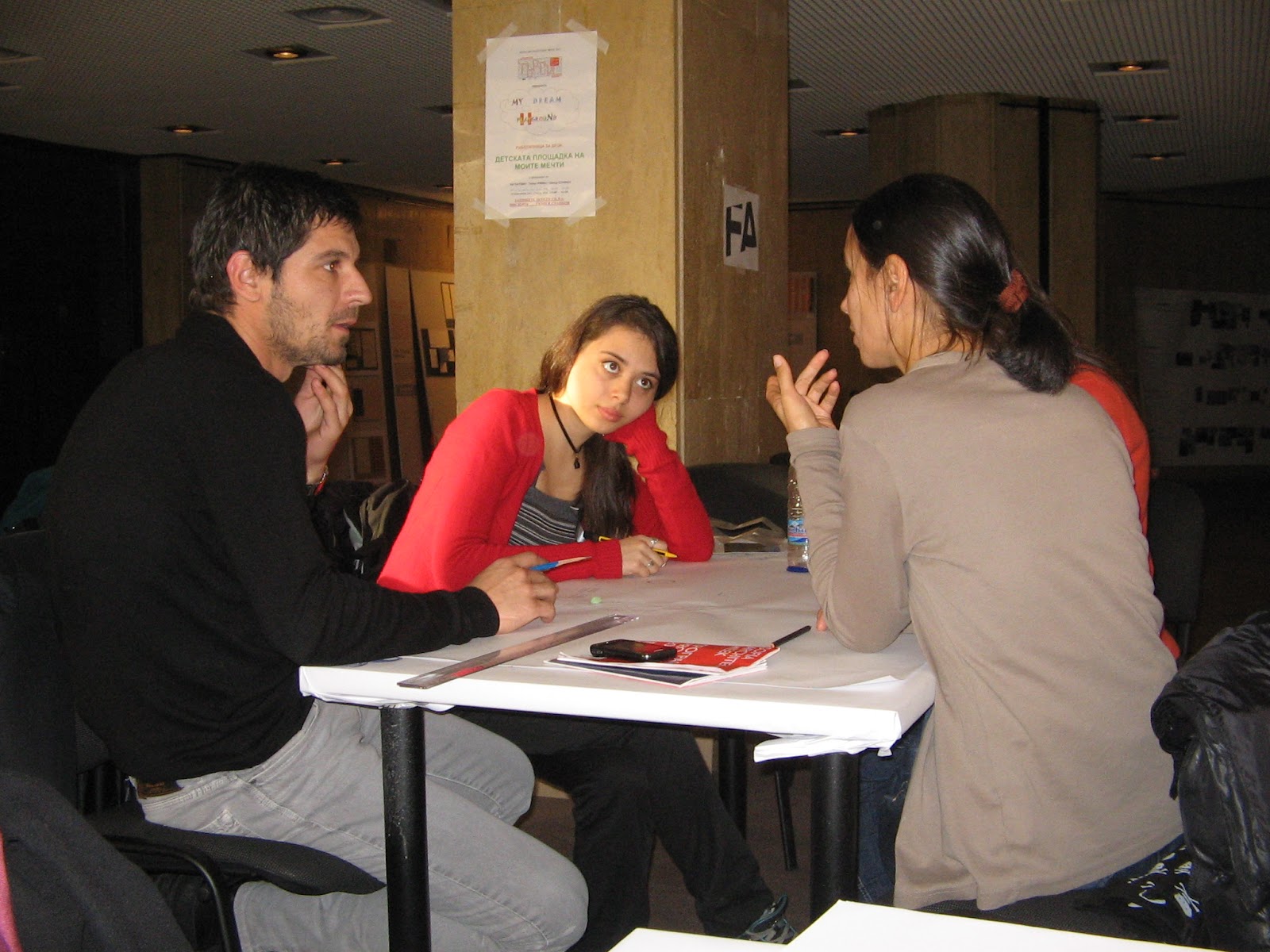
Our first workshop was held on Wednesday, the 28th of November. Its name is "My Dream Playground" and we made this workshop for a first time during Izmir Architecture Week 2012. 

Workshop's primal idea is to support the process of children's participation in today's society, and to involve children in the decision-making process regarding their own environments, spaces, and valuable places.

Methodology: 

We achieved this goal by getting together children and  professionals, who design children's environment: architects, designers, urban planners, and so on. Before the workshop we trained the professionals how to work with children, by enhancing their social competence and communication skills. Then we invited children from elementary schools to work collaboratively with the adults and to create common projects. The results were very encouraging!


THE SECOND WORKSHOP

The second workshop was a brave experiment, entitled "Playgrounds, Ideas and Ideologies", and we held it on 29th of November. We invited the participants of the workshop with the following tempting proclamation:
Is it possible that playgrounds reflect ideological concepts? This workshop will give you an open space to:
 - explore how specific ideologies, social trends, public attitudes, and concrete historical events might reflect the surrounding environments, including children’s ones
- create your own society with history and... playgrounds
- discuss and share creative ideas with others. 
Methodology:

We started with presentation on the influence which various political events, social issues, economic, cultural and even ideological trends might have on the public design, and especially on the children's public spaces. At the second part of the workshop, we formed several small groups, and each of them made a simulation of a society and created design for children's spaces of this society. The participants had very different professional backgrounds: architects, economists, construction engineer, designers, web developers, students, house wives, entrepreneurs, and this rich diversity helped them to produce incredibly creative projects!


THE LECTURE 

On November 29th, the third day of our participation, we gave a Lecture on the research "Haskovo Playgrounds: In a Transition from Communism to the Modern Times" in Hall 6 of the National Palace of Culture. We presented the research and shared our basic findings, and after that we answered questions from the audience..

* * * * * * *
We are satisfied with our participation in Sofia Architecture Week 2012, and we believe that our humble contribution will give valuable insights to the architectural community in Bulgaria and abroad.
We would like to thank to the curators of SAW 2012 - Delcho Delchev and Valeri Gyurov, and to the program coordinator of SAW 2012 +Boyka Ognyanova for their great support! 

Sunday, 11 November 2012

Today's guest in Open School of Psychology - Ivan Delchev

by: Georgi Stankov

Today at Open School of Psychology we had a honorable guest - Mr +Ivan Delchev - co-founder and co-owner of Soft Consult Group. He is the head of the company's Quality Assurance department and a successful independent internet marketing consultant. 

Mr Delchev shared with OSP's students his company's experience and fundamental principles in management, leadership & co-leadership, staff recruitment and training, and the overall process of developing a new product from the initial discussion with the client, through the test and re-test procedures, to the final implementation. We also used Mr Delchev's competence and asked for his feedback on our very new Small world project.

Later we made an analysis of the interview with Ivan Delchev. The students discussed the psychological aspects of what we learned about the software development companies and their work. 

Photos in three steps:
We are very official... and stiff as trees :)
Ivan Delchev is the high man with white-grey shirt.

Here I show to students how to overcome the camera stress.

He-he... We rule!


We will upload the video from the interview with Mr Delchev in two weeks. Of course, we will inform you in time - this conversation is a worth watching!

Tuesday, 6 November 2012

Short report from OSP: recent deeds

by: Georgi Stankov

1st row: Seli, Yanko, and Krisi; 2nd row: Kito, Stoyo, Georgi, and Petya.
 Here is a very short report about what is going on with our Open School of Psychology.

As you already know, we started our first academic year three weeks ago with eight students. Fortunately, the group cohesion is growing. I have noticed that after three weeks of getting to know each other, now the members are more open, devoted and creative. On Sunday we were very productive. As result we built the foundation of our study of small world phenomenon via online social networks. By the way, the regular themes of the day were SWOT-analysis and smart-goals. I encouraged students to use these new tools while discussing and planning our team's next steps.

Two of our students were missing because of their SAT 1 in Plovdiv, but next week we will be together and hopefully we will work even more efficiently.


Moments from the discussion: the gents were enthusiastic and action-oriented, and the ladies were more skeptic and analytically-thinking-oriented. :)

Small world phenomenon revisited

by: Georgi Stankov

Stanley Milgram (1933 - 1984)
We are happy to present the new initiative of Open School Psychology, the psychological division of The Garden Association: Milgram's small world revisited. 

"Small world revisited" is a project, inspired by Stanley Milgram's classical social networks' experiment, known as "Small world phenomenon" or "Six degrees of separation". 

Milgram found out that between two distinct (both in physical also social terms) persons there are average six degrees of separation, e.g. John could reach Tom in six steps (1st - acquaintance, 2nd - acquaintance's acquaintance, 3rd - acquaintance of acquaintance's acquaintance, and so on). Our team of students, led by Georgi Stankov, will revisit and retest Milgram's experiment, by adapting it to today's conditions.

In the 1960s there was not internet, so Milgram made his experiment through the offline networks. The social scientists of the time did not think that in few decades there will be a powerful alternative for establishing and maintaining relationships, as well for exploration of the social bonds between people. But today the majority of people use the Internet to communicate quickly and easily, relationships became more informal, and as result locations or distances stopped having importance.  Now, in 2012, we try to research the online social networks and how they link people. 

Sunday, 14 October 2012

The first graduating class of Open School of Psychology started today

by: Georgi Stankov

Today our Open School of Psychology began its first graduating class.

Greet our first students: Dimitria, Kristina, Selime, Galya, Petya, Milena, Yanko, Kito, Stoyo, and Atanas.

The class' contents include (but it is not limited to):

  • Personality psychology and personality types; 
  • Social psychology and interpersonal relations; 
  • Cognitive psychology, creativity and creative thinking;
  • Organizational psychology and team work; 
  • Positive psychology and Health psychology;
  • Forensic psychology and antisocial behavior; 

Additionally, through various activities and techniques from psychodrama, art therapy, and encounter group's approach, students will have opportunity to:

  • achieve better self-understanding via self-exploration and self-discovery 
  • improve their competencies for social adjustment and public performance 
  • increase their abilities for effective communication and assertiveness 
  • overcome hard times in their lives 
  • experience a new and exciting approach for teamwork 

Sunday, 7 October 2012

The Garden Association at Izmir Architecture Week 2012

A short photo reportage about our participation at Izmir Architecture Week 2012: with +Turkan Fırıncı, +Georgi Stankov and our partner from Izmir Children's Atelier Mrs +Elif Kayran. Our workshop and presentation took place on the 4th and 5th of October.

We are very thankful to Prof. Hikmet Sivri Gökmen from Dokuz Eylül University for her kind invitation and hospitality. Also we thank to her team of young and beautiful students, who attended the workshop and the presentation.

With Prof. Gökmen and her students
Meeting the kids. Most of them were from a disadvantaged
Roma community in the suburbs  of Izmir. This was their
first contact with psychologist and architects
And her ewe are already arkadaşlar.
Our team - Turkan and Georgi - with the kids and their tutor.
Training for the architecture students from Dokuz Eylül University.
We taught them how to work and effectively communicate with children.


THE WORKSHOP ITSELF:


Me with several kids
 These are the products of the collaborative work of children and students of architecture: great projects for playgrounds!


Exhibition